Role
UX/UI Designer
UX Researcher
Skills
Research Analysis
User Interviews
Storytelling
Wireframing & Prototyping
Team
3 Designers
Duration
24 Hours
Overview
Touch Grass.
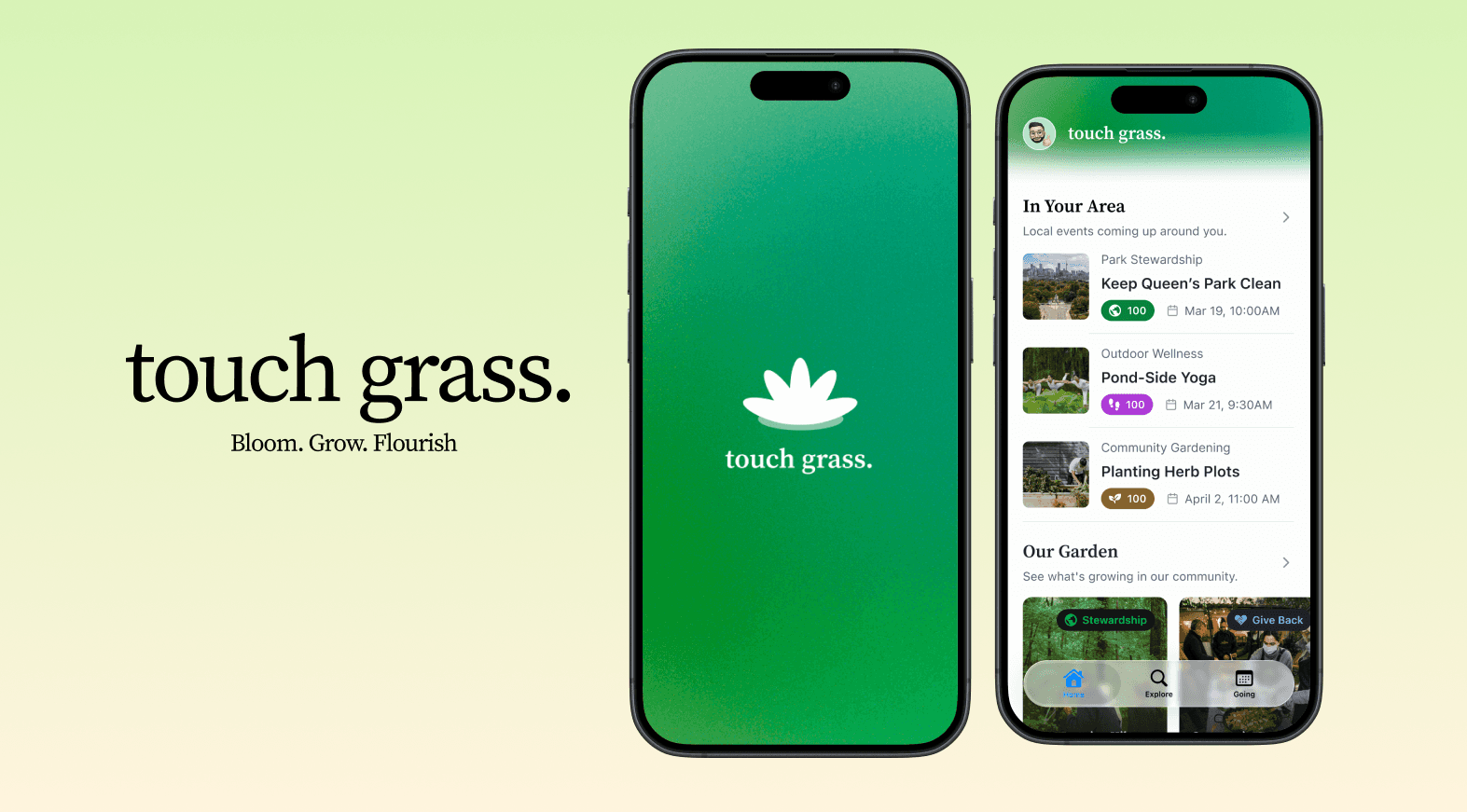
Touch Grass is a sustainability tool that helps people make eco-conscious contributions in their community by connecting them with local sustainability initiatives through personalized discovery and goal-based badges

Design Task
In 24 hours, we were tasked to design for a sustainable future
"As generative AI evolves rapidly, there is an exponential rise in augmented and distorted versions of the real-world. People are becoming more susceptible to AI-generated realities and struggle to distinguish what's real from what's not. To make matters worse, these fake realities are created at great risk to our global water supply and air quality."

Secondary Research
While AI tools have accelerated the way we interact and perceive the digital world, research revealed this has reduced investments into sustaining long term human relationships

User Interviews
User interviews validated that AI had negatively changed the way humans interact online and offline

During interviews, sustainability was linked to positive feelings of community building and personal fulfillment

The findings showed that designing for an AI world isn't just about improving how we use AI, but about creating opportunities for people to reconnect with their surroundings
Rather than tackling AI's environmental impact directly, we chose to address its root behavioral cause
Solution
In an increasingly digital age, people need opportunities to make real connections with the world through local sustainability initiatives and goal-based rewards
Competitor Analysis
Competitor analysis revealed there was gap in the market for a sustainability-focused discovery platform
City of Toronto

Low discoverability on initiatives
Information buried under existing information architecture
Eventbrite

Large database for event discovery
Minimal tools for sustainability and environmental impact
Meetup

Large emphasis on career networking
Monetizes features and incentivizes info through paywalls
User Persona
Lukas is a tech-savvy individual who has grown dependent on AI for social interaction and is looking for a way to build meaningful connections

He wants to find opportunities to not only socialize and build community, but help push for personal growth

User Task Flow
Our task flow centered on discovery, registration, and attendance, along with how users would earn badges and points through event verification codes.

Ideation
We looked at current event platforms to help brainstorm ideas for our screen design

Style Tile
We defined what we liked, and created the artistic direction we wanted our design to portray

Final Design
To support sustainable design for the future of the planet, Touch Grass's goal is to bring human connection back into our routines to encourage future-self goal making.
Bloom in your community
Find local events, meet new people, and contribute to a sustainable community.
Grow your goals & flourish
Aim for eco-conscious goals, gain points with every contribution, and earn new sustainability badges.
Design System
Due to time constraints, having key components helped us design efficiently and ensured design consistency

Takeaways
Here are the key takeaways I learned during this 24 hour designathon

Trusting the process, even
under pressure
Despite tight time constraints, our mentor encouraged us to skip mid-fidelity and jump straight into building a high-fidelity prototype. Despite the risk, we trusted his guidance and our abilities. As a result, we were one of few teams to deliver a fully working high-fidelity prototype, which let us test and present a much more realistic representation of our product

Leveraging strengths
as a team
As a team of three designing under a 24 hour deadline, we made sure to assign roles and tasks based on each person's strengths. While everyone contributed across different aspects of the project, this division of labour let us prioritize effectively and stay organized and efficient under tight time constraints